Building AI for human learning: why we invested in Aristotle
Today Shan, Jaiden, and Vivek launch Aristotle to the world: a voice-first AI tutor that talks with a student, draws on a shared whiteboard, remembers where they got stuck last, and keeps their parents in the loop. True led their seed round, and we’ve had the privilege of watching them and their team build it from a few blocks away.
The holy grail
We've known for decades what works in education — one-on-one instruction, mastery before moving on — and that it doesn't scale. A great tutor is gold, and almost nobody gets one.
A tutor for every child in the world is one of the holy grails of AI. When Shan first walked me through the idea, the framing was simple: we’re not reinventing learning, we’re putting great teachers into software and giving one to every kid.
Inside the tutor
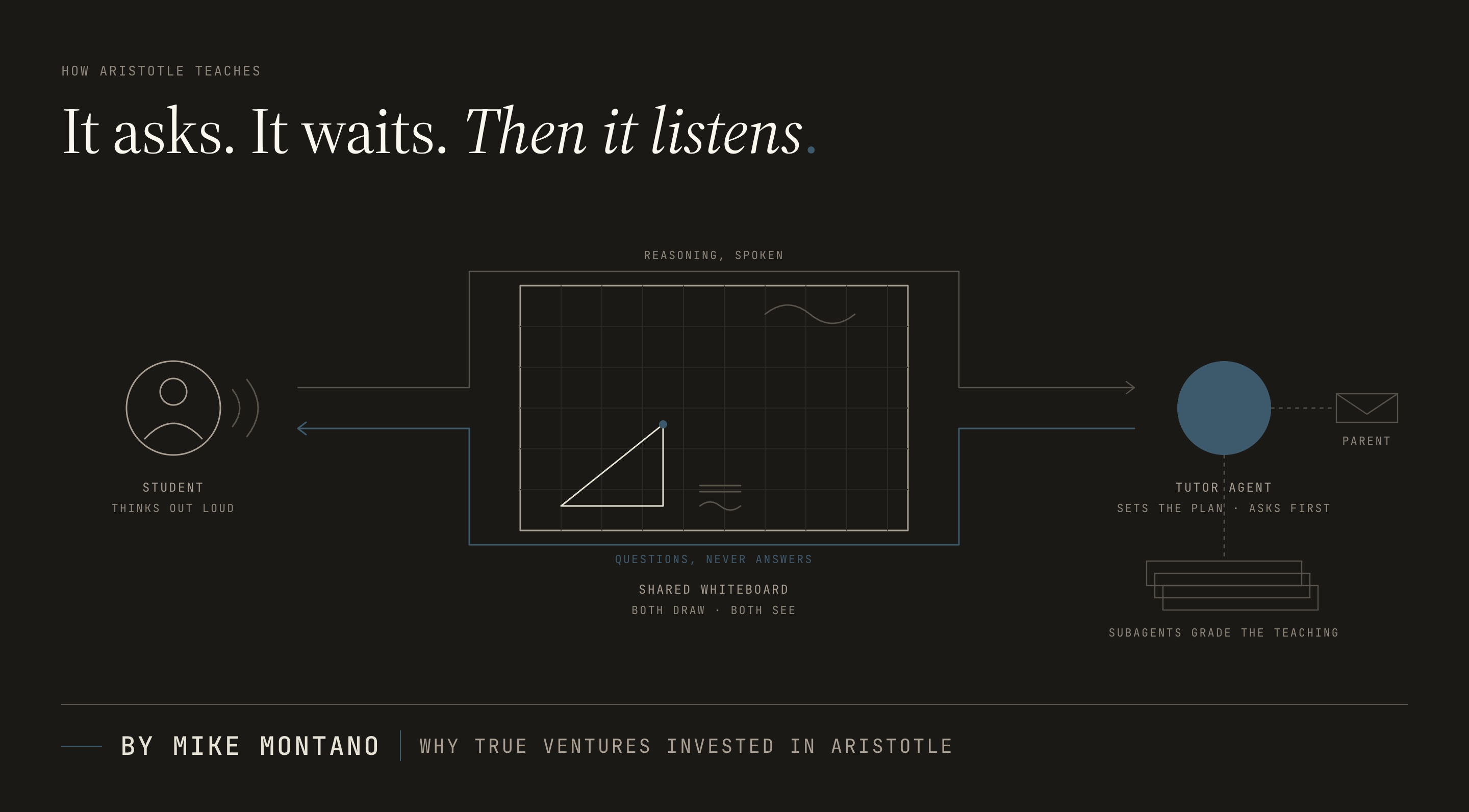
At an engineering and product level Aristotle is a multi-agent harness purpose-built for learning. The tutor agent is proactive – it sets the plan for the session instead of letting the student drive – which is a novel and fascinating behavior pattern for consumer AI. It also asks before it tells. It waits while a kid works the problem out loud, then has them explain their reasoning back before moving on. Behind the voice in the room sits layers of specialized subagents evaluating teaching quality, curriculum consistency, and more.
Underneath is a dataset nobody else has: thousands of hours of graded, multi-turn tutoring conversations, and a first-of-its-kind multimodal eval set for a nonverifiable task — influencing what a person actually knows. 'Did the code compile' is nearly solved. 'Did this kid learn,' across a 175-message session, is not.
Why LLMs are not good teachers
Hand the most high-parameter high-thinking model ever built to a 15-year-old with a chemistry test tomorrow and it does exactly what it was trained to do: answer.
Not because it's wrong – because it's helpful. Answering is the one thing a tutor must not do. Learning happens in the productive struggle, and when a model hands over the answer it removes the exact step where learning happens. The student feels great, but nothing sticks.
Vivek saw this before he built anything. As an undergrad at Stanford, he surveyed hundreds of students on how they used LLMs and found that almost none were using them to learn. Most saw them as a cheating tool. Two years later, that hasn't changed.
How they build
Before they’d settled on education, Shan, Jaiden and Vivek spent a summer asking how much infrastructure a three-person team could build to operate like twenty. Each founder shipped a separate product in a week by orchestrating coding agents. Today each runs a main task and three or four agent-driven tasks in parallel, and a real share of their week goes to harness engineering: restructuring logs, tests, and docs so their agents do better work.
A decade ago I'd have told an inception-stage team to spend zero time on internal infrastructure. Aristotle is a big part of why I no longer say that. Leverage that used to cost months of runway now costs days, and the teams that build it early spend more time with customers, not less. The old questions still come first: who follows them, who takes the leap at real cost to themselves. Right next to those, I now watch how a team uses AI to multiply itself.
Shan, Jaiden, and Vivek
All three have deep roots at True. Shan was an investor here, and Jaiden and Vivek were True fellows who went on to engineering roles at Veza and Aisera. Shan and Jaiden went to the same underfunded public high school in Las Vegas and learned early how to route around a system that wasn't built for them. Vivek did LLM reasoning research at Stanford and calls the classroom the slog of his life, and learning on his own the joy.
First to Believe. All In.
Aristotle starts with 13- to 18-year-olds, sold to parents at a price that reflects what a real tutor is worth. It will go much further. Every learner, every subject.
Congratulations on the launch, Shan, Jaiden, and Vivek.
Excited to be doing this with you.