The org chart is getting weird: why we invested in TokenCompass
Every team is buying tokens. Nobody can attribute the bill. Mike Montano on why True backed Ian Chan and TokenCompass, the system of record for AI labor.
The job of a manager has remained roughly the same for as long as I can remember. You get a budget. You turn the budget into people. You turn people into output. Then you try to figure out whether the output was worth the budget.
Every system we've built to run a company assumes that shape. Headcount plans. Comp bands. Onboarding and offboarding. Performance reviews. HR. ERP. Workday… It's all scaffolding around a single unit: a person, who costs a knowable amount per year and produces a knowable amount of work.
Sometime in the last eighteen months, that assumption quietly broke.
Today an engineering leader can deploy a fleet of agents on a Tuesday afternoon and ship a quarter's worth of work by Friday. The work still gets done. The money still gets spent. But the labor doesn't show up on the org chart, doesn't have a manager, doesn't get a review, and (in most companies I talk to) doesn't get reconciled against any budget at all.
When the unit changes
I don't think of this as a tooling problem. I think of it as a labor problem. AI is a form of labor. It's bought, deployed, managed, measured, and retired, just like the human kind. And the second you frame it that way, the whole familiar catalog of management problems comes back wearing new clothes:
How much are we spending, and on what?
Who authorized it?
What’s the ROI?
Which parts of this work give us greater output and value, and which should we shut off?
What are agents allowed to touch?
And who is accountable when they do something wrong?
Those are HR questions, finance questions, and IT questions. And right now, in a company that's half humans and half agents, essentially nobody has a system of record that can answer them. Finance has a spreadsheet. Engineering has a credit card statement. Leadership feels aloof.
I've come to believe there's a very large company to be built at that intersection — the ERP, or the Workday, or whatever we end up calling it, for a workforce where a meaningful share of the output isn't human. Spend, identity, work, impact. All four, in one place. Which brings me to Ian...
Ian Chan and TokenCompass
I've known Ian for about fifteen years, and the way we met is a little unusual. He was the person Twitter put in charge of integrating my company. When BackType was acquired, Ian was our deal shepherd. He owned the integration — our team, our technology, our architecture, our product, and a good chunk of our culture.
If you've ever been acquired, you know how much that role determines whether the experience is great or miserable. Ours was great, and that was mostly Ian.
Then we stayed. Ian reported to me at Twitter, leading analytics and publisher products across consumer and advertising platform teams. Together, we defined core analytics that helped build Twitter’s advertising business.
Ian left in 2015; I stayed and later went on to run all of Twitter engineering. The analytics we built together remained largely in place through 2021, when Twitter’s annual revenue exceeded $5B.
After Twitter, he spent the next decade leading other orgs through a version of the same problem: attribution infrastructure, financial data at its ugliest, and most recently a large org moving through the AI transition in real time — evaluating, adopting, and retiring tools the entire way.
Look at that path and TokenCompass — Ian's new company, which True just funded — isn't a pivot. It's the obvious next step.
TokenCompass starts somewhere very concrete: connect your AI platforms — OpenAI, Anthropic, Cursor, the long tail of providers — and get one honest picture of every token your organization is spending, by person, by agent, by team, by model, by project. Built for finance and leadership rather than for engineers.
That's the wedge, and it sells today, because every CFO in America just discovered a line item that didn't exist last year and grows every month.
But the detail that told me where this actually goes is small and, I think, wonderful. In the product there's a toggle: show agents, hide agents. It exists because when Ian put a spend leaderboard in front of a customer, a chunk of the names on it weren't people — they were agents, attributed back to the human who deployed them. Sometimes the customer wanted to roll it up to the human. Sometimes they wanted to see only the machines.
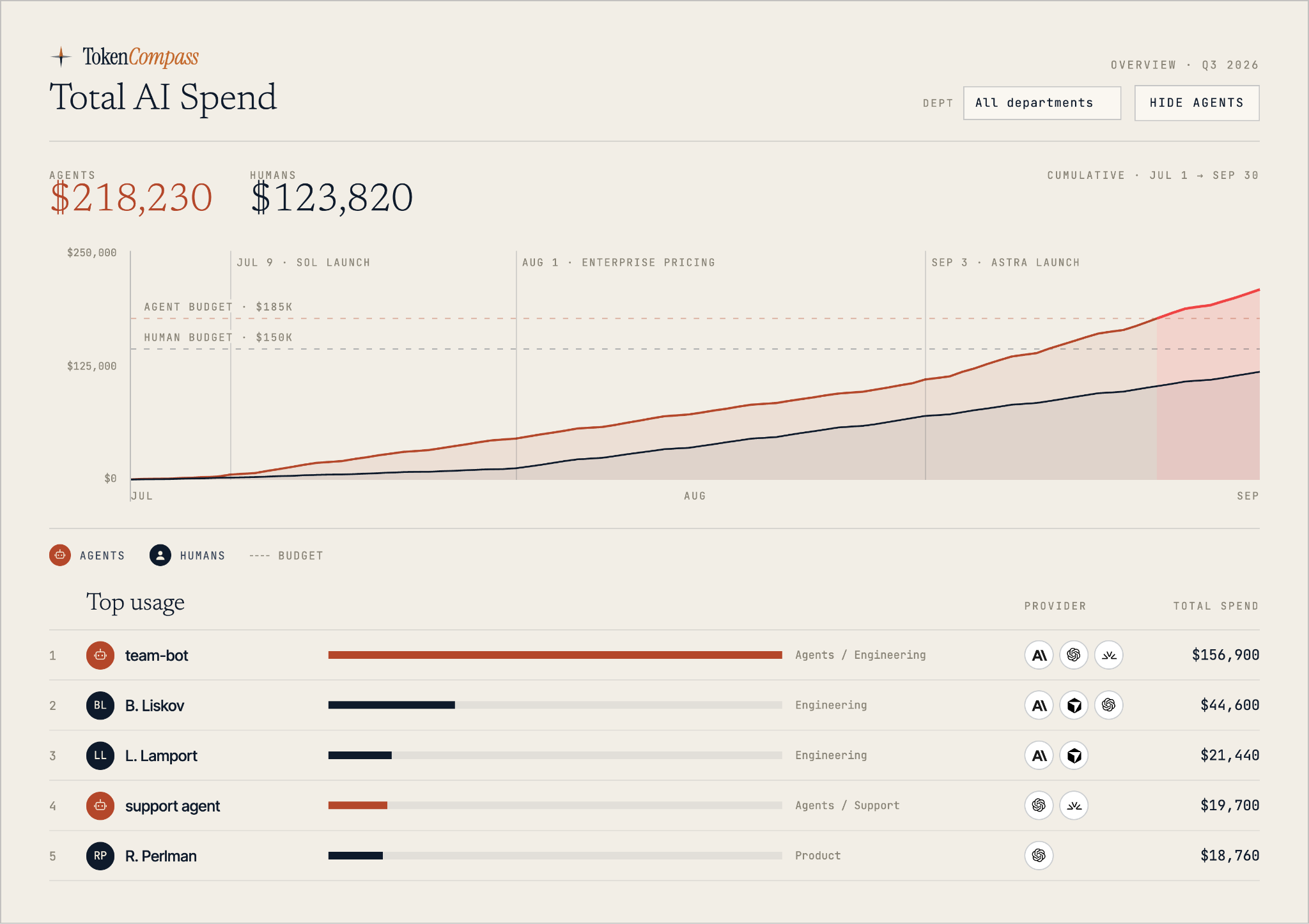
That toggle is a workforce management problem hiding inside a dashboard. And it's going to get much bigger than engineering. Every function is about to have a token budget and a manager who has to defend it. The unit of work is changing. Something has to keep the record.
First to Believe. All In.
He’s also a strong builder, with the rare advantage of having been the buyer of the kind of product he’s now building. I’m excited to see him take everything he’s learned and apply it to TokenCompass.
I’ve worked with a lot of people over twenty years, and Ian is someone I’ve always respected. He’s honest, deeply curious, hard-working, and unusually focused on understanding the customer.
It's early. It's a solo founder and, in his words, an army of agents. That's exactly the moment we like to show up.
Congrats on the round, Ian. Very glad to be working together again as you grow TokenCompass.